
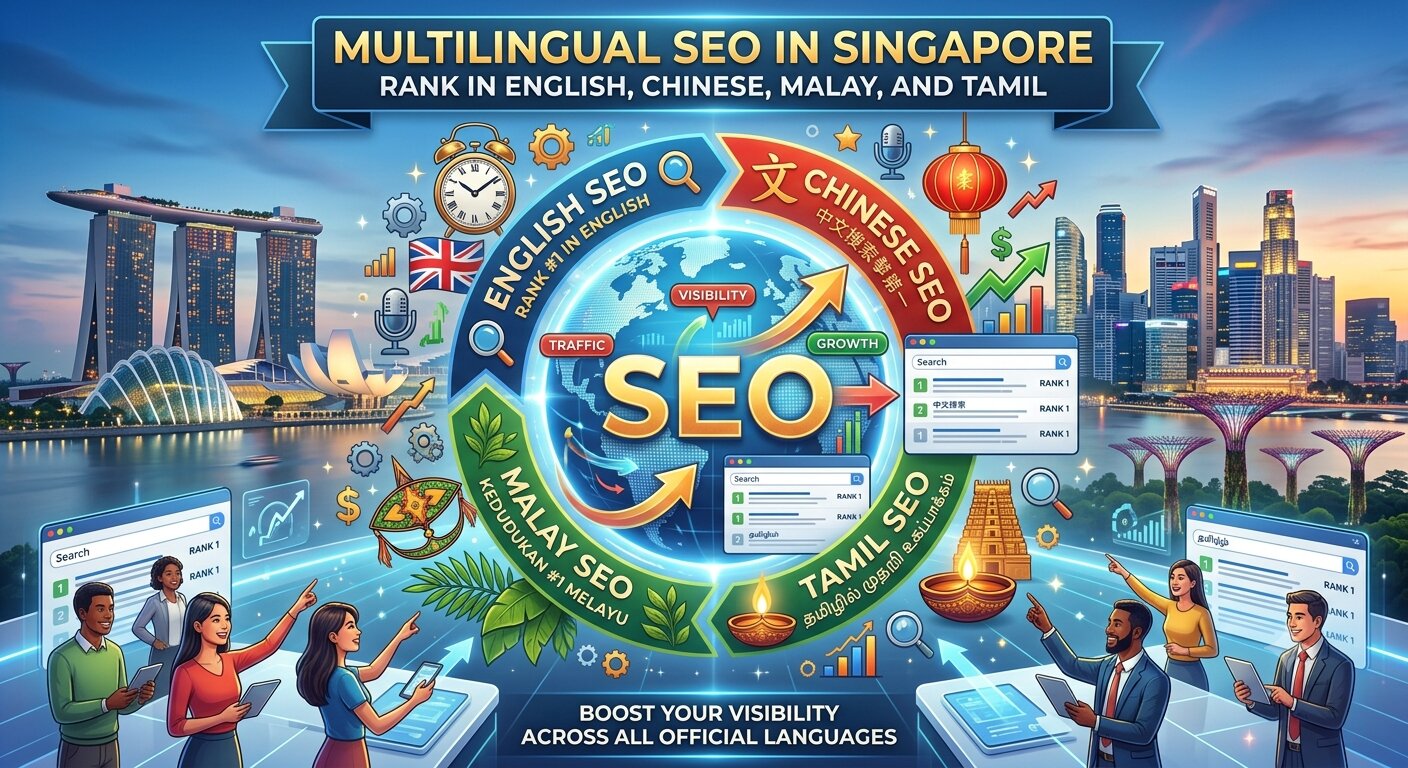
Singapore businesses that only optimise for English are, by definition, invisible to more than half their potential customers. According to the 2020 Census, 48.3% of residents speak English most frequently at home — meaning the majority speak Mandarin, Malay, Tamil, or a Chinese dialect as their primary home language. Multilingual SEO Singapore is the practice of structuring your website to rank across all four official languages so you capture search demand that single-language competitors cannot touch. In this guide, I’ll walk you through exactly how to do it — from keyword research in Chinese and Malay to hreflang implementation, content strategy, and the technical foundations that determine whether search engines serve the right language version to the right user. This is the same approach I apply to multilingual SEO campaigns for Singapore clients across healthcare, F&B, legal, and professional services.
Key Takeaways
- Singapore’s linguistic diversity creates an SEO opportunity most businesses ignore — ranking in Chinese, Malay, and Tamil lets you reach audiences your English-only competitors cannot
- Multilingual keyword research is not translation — search patterns, terminology, and intent differ meaningfully between languages and even between regional variants of the same language
- Correct hreflang implementation is foundational, yet 97.5% of multilingual websites get it wrong, causing search engines to serve the wrong language version to users
- A subdirectory URL structure (example.com/zh/, example.com/ms/) consolidates domain authority and is the recommended approach for most Singapore businesses
- AI search engines like Google AI Overviews and Perplexity are expanding multilingual capabilities rapidly — businesses that build authoritative multilingual content now will benefit disproportionately as these platforms improve
Why Multilingual SEO Matters in Singapore’s Market
Multilingual SEO in Singapore delivers a direct competitive advantage: you rank for search queries your competitors have never even considered targeting.
The numbers make the opportunity concrete. According to Singapore’s 2020 Census, 29.9% of residents speak Mandarin most at home, 9.2% speak Malay, and 2.5% speak Tamil. Combined, that’s more than 40% of the resident population with a non-English home language — a substantial audience searching Google in their mother tongue every single day. And 74% of Singapore residents are bilingual or multilingual, meaning many users switch languages mid-session, particularly in searches that combine English and Mandarin in the same query (a pattern called code-switching, which I’ll return to shortly).
The competitive gap is striking. A keyword like 中医诊所 新加坡 (TCM clinic Singapore) attracts around 380 monthly searches with relatively low competition. Its English equivalent, “traditional chinese medicine Singapore,” gets 720 searches but is far more contested. For many service businesses, the Mandarin keyword is actually the easier ranking opportunity — simply because so few competitors have pursued it.
Older demographics compound this further. The median age in Singapore is 43.2 years, and among residents aged 55 and above, Mandarin and Chinese dialect usage at home significantly outweighs English. If your business serves an age-diverse customer base — and most do — an English-only website is silently excluding a large portion of your potential patients, clients, and customers.
The industries where I see the sharpest multilingual search gaps are healthcare, legal services, F&B, education, and financial services. These are exactly the sectors where trust matters most and where customers are most likely to search in the language they’re most comfortable with.
If you want to understand how multilingual SEO fits within your broader Singapore search strategy, the foundation starts with your overall SEO approach for the Singapore market.
What Languages Should Singapore Businesses Target for SEO?
The four official languages of Singapore — English, Mandarin Chinese, Malay, and Tamil — each represent a distinct search audience, search behaviour, and competitive landscape.
English
English is Singapore’s lingua franca and the primary language of commerce and education. It dominates most professional and B2B search categories. The majority of existing SEO content targets English, which means competition is highest here. Starting with solid English SEO is essential, but it alone cannot maximise your market reach.
Mandarin Chinese (Simplified)
Singapore uses Simplified Chinese, not Traditional Chinese as used in Taiwan and Hong Kong. This distinction matters enormously for keyword research and content creation — the same concept can have different search terms across these regions, and targeting the wrong script variant produces the wrong results. Mandarin represents the largest non-English search opportunity in Singapore, particularly for service businesses. Code-switching is extremely common here: searches like 最好的律师 Singapore (best lawyer Singapore) or tuition 补习 near Tampines blend Mandarin and English in ways that most standard keyword tools miss entirely. Work with someone who actually searches in Mandarin as a Singaporean — not a mainland China speaker — because local phrasing differs significantly.
Malay (Bahasa Melayu)
Around 15% of Singapore’s population is Malay. Bahasa Melayu as spoken in Singapore has subtle differences from Malaysian Malay, and while search volumes for individual Malay terms are lower than for Chinese, the audience is underserved and largely ignored by most Singapore businesses. High-intent Malay searches appear most frequently in F&B, community services, Islamic finance, halal retail, and education. A business that properly targets these queries faces minimal competition from the outset.
Tamil
Tamil search volumes in Singapore are smaller than the other three languages, but the audience represents an engaged, often underserved community. Focus on high-intent service categories where Tamil-speaking residents are most likely to search in their mother tongue: healthcare, legal services, religious services, and education.
How to Do Multilingual Keyword Research for Singapore
Multilingual keyword research is not translation. This is the single most important principle to understand before you begin.
Running your English keyword list through Google Translate and calling it a Chinese SEO strategy will produce content that real Singaporean Mandarin speakers would never search for. The phrasing is different, the intent signals are different, and the terminology varies between Singapore and mainland China even for the same concept.
Here is the process I use for Chinese SEO keyword research in Singapore:
- Start with native Singaporean speakers. 网页设计 (web design) is standard in Singapore. Mainland China speakers often use 网站建设 instead. That gap produces entirely different search results, and optimising for the wrong term is worse than doing nothing
- Use Ahrefs or SEMrush with Singapore as the target country. Both tools support Chinese character queries. Search for core service terms in Chinese and examine real search volumes and SERP competition for the Singapore market specifically
- Check Google Autocomplete in Chinese. Switch your Google interface language to Chinese (Simplified) and type your core terms. The autocomplete suggestions reveal exactly what Singaporean Mandarin speakers are searching
- Research Hanyu Pinyin variations. Some Singaporeans type Pinyin (romanised Chinese) on mobile instead of characters — 中医 searched as “zhong yi” is a real keyword worth capturing
- Map mixed-language (code-switching) queries. Searches like best 补习 Singapore or 律师 near Jurong East blend both languages. Google’s own research confirms that bilingual speakers globally use mixed-language queries regularly — and these patterns are especially pronounced in Singapore
For Malay and Tamil keyword research, the methodology is the same. Identify native-speaker search patterns, use keyword tools with Singapore as the geo-target, and validate findings with actual Singaporeans who search in those languages daily.
Hreflang Implementation for Singapore: Getting It Right
Hreflang tags are HTML annotations that tell search engines which language version of a page to show to which user. Without them, Google may serve your English homepage to a Mandarin-speaking Singaporean, or index the wrong language variant as the canonical — effectively making your multilingual content invisible.
A staggering 97.5% of multilingual websites fail to implement hreflang correctly. The errors range from missing self-referencing tags to incorrect language codes to incomplete bidirectional references.
For a Singapore multilingual website, the correct hreflang codes are:
| Language | hreflang code |
|---|---|
| English (Singapore) | hreflang="en-sg" |
| Simplified Chinese (Singapore) | hreflang="zh-Hans-sg" |
| Malay (Singapore) | hreflang="ms-sg" |
| Tamil (Singapore) | hreflang="ta-sg" |
| Default fallback | hreflang="x-default" |
Every page must include a self-referencing hreflang tag (pointing to itself) and tags pointing to all its language variants. Every variant page must also point back to all the others. This bidirectional relationship is what most implementations miss.
Common hreflang mistakes I catch when auditing Singapore sites:
- Using
zhorcninstead ofzh-Hans-sgfor Simplified Chinese Singapore pages - Forgetting the
x-defaultfallback tag - Implementing hreflang only on the homepage and not on service pages
- Creating hreflang tags that don’t match the actual language of the page they reference
Google Search Console’s International Targeting report will surface hreflang errors if you check it regularly. This is one of the first things I review in any multilingual SEO audit.
How to Structure a Multilingual Website for SEO
URL structure is a foundational decision that affects both how search engines index your multilingual content and how authority flows across your site.
Subdirectories are the right choice for most Singapore businesses. This means your English site lives at example.com, your Chinese version at example.com/zh/, Malay at example.com/ms/, and Tamil at example.com/ta/. Subdirectories consolidate domain authority into a single property (unlike separate domains like example-chinese.com), are easier to manage than subdomains, and align with what Google recommends for most multilingual implementations.
Separate domains only make sense if you are targeting entirely different countries with distinct brand identities — which is not the case for a Singapore business serving Singapore audiences across four languages.
Beyond URL structure, two other technical elements define multilingual SEO performance:
Structured data in every language. Your JSON-LD schema (LocalBusiness, Service, FAQ) should exist on every language version with the inLanguage property set correctly. When your Chinese page has proper LocalBusiness schema with the business name in both English and Chinese characters, AI search engines are significantly more likely to cite you for Mandarin queries. This is increasingly important as Google AI Overviews, Perplexity, and ChatGPT expand their multilingual capabilities.
XML sitemaps with hreflang mappings. For sites with substantial multilingual content, managing hreflang through your XML sitemap is more efficient than embedding tags in every page’s HTML head. This centralises management and simplifies scaling as you add new content and languages.
Multilingual Content Strategy: What to Translate vs. Create Natively
Not every page on your site needs to exist in all four languages. A smart multilingual content strategy prioritises the pages and queries where non-English search demand actually exists — then ensures the content in each language is built to rank, not just to exist.
Always localise these pages first:
- Homepage and core service pages (commercial conversion pages)
- Contact page and location information
- Key landing pages targeting high-volume non-English queries
- Google Business Profile content — name, description, posts, and Q&A
Create natively for these (do not just translate):
- Blog posts targeting language-specific search queries. The questions Mandarin speakers ask about healthcare are often different from the questions English speakers ask. Write fresh content addressing what that audience is actually searching for
- FAQ content. The phrasing of frequently asked questions differs significantly across languages and cultures
- Testimonials from clients in that language community — these build trust with native-language readers in ways that translated testimonials never quite achieve
Generally skip translation for these:
- Technical blog content written for an English-speaking professional audience
- Thought leadership pieces where the target audience primarily searches in English
- Pages with minimal demonstrable non-English search demand
The distinction between translation and native content creation matters for both rankings and AI search visibility. Machine-translated content — even when reviewed by a human editor — often reads as unnatural to native speakers. AI search engines are increasingly capable of detecting translated versus natively written content, and they favour the latter. Building content that reconstructs the intent, authority, and phrasing of your messaging in the target language — rather than simply converting words from one language to another — produces meaningfully better results in search rankings and AI citations alike.
A practical starting point: begin with your top five commercial pages in Chinese. Mandarin speakers represent the largest non-English search audience in Singapore at approximately 30% of the population. Measure the impact over three months, then expand to additional pages and languages based on the traffic and conversion data.
How Multilingual Content Performs in AI Search
AI-powered search is accelerating the value of multilingual SEO in ways most businesses haven’t anticipated yet.
Google AI Overviews expanded to over 200 countries and nearly 100 languages in early 2026. ChatGPT and Perplexity handle multilingual queries with growing sophistication. The practical implication for Singapore businesses: when a user asks Google AI in Mandarin for the best TCM clinic near Toa Payoh, or asks Perplexity in Malay for a web design firm in Singapore, your content either surfaces or it doesn’t. There is no middle ground.
Current testing shows that Google AI Overviews and Gemini perform best with multilingual content, drawing on decades of Google Search’s experience with hreflang signals and language detection. If your site has correctly tagged Chinese content with proper structured data, Google’s AI summaries are more likely to cite it for Mandarin queries. ChatGPT currently tends to cite English-language pages even when the query is in Mandarin — but this is changing as the platform improves non-English retrieval. Perplexity is similarly developing, with active improvements to source retrieval across languages.
The window of opportunity is open right now. Most Singapore businesses haven’t begun thinking about multilingual SEO for traditional search, let alone for AI search. Businesses that build genuine multilingual authority today will be the sources AI engines learn to trust and cite as their multilingual capabilities mature.
Common Multilingual SEO Mistakes Singapore Businesses Make
After more than 30 years doing SEO across Singapore and international markets, I see the same mistakes repeated in almost every multilingual audit I conduct.
Using machine translation for keyword research. 律师 translates to “lawyer,” but Singaporean Mandarin speakers searching for legal help are far more likely to type 新加坡律师事务所 (Singapore law firm) or 律师 靠近我 (lawyer near me). Machine translation misses the actual phrasing of real searches.
Missing or broken hreflang tags. The 97.5% failure rate is real. The most common errors: missing self-referencing tags, incorrect language codes like cn instead of zh-Hans, and non-bidirectional references between language variants. Use the International Targeting report in Google Search Console to catch these.
Automatic IP-based redirects. Never force users into a language version based on their location or browser settings. A Mandarin speaker may want your English page, or a bilingual user may alternate between versions. Aggressive redirects also prevent Googlebot from crawling all language variants — which directly harms your rankings.
Partial translations. A Chinese version of your site where headers are translated but body copy remains in English confuses both users and search engines. If you’re going to commit to a language, commit fully. Half-done multilingual content is worse than no multilingual content.
Ignoring Google Business Profile language settings. Your GBP supports multiple languages. If you serve Chinese-speaking customers, your business description, services, and Q&A should include Chinese content. This is one of the fastest wins for multilingual local visibility and one of the most consistently overlooked.
Treating all Chinese speakers as one audience. Simplified Chinese (Singapore, mainland China) and Traditional Chinese (Taiwan, Hong Kong) are different writing systems, and search terminology differs between Singapore Mandarin speakers and mainland Chinese speakers. Optimising for the wrong variant means missing the audience you’re actually trying to reach.
How I Deliver Multilingual SEO Results in Singapore
My approach to multilingual SEO for Singapore businesses is systematic, data-driven, and built around measurable outcomes — not activity metrics.
Here’s what the process looks like in practice:
Multilingual keyword research. I work with native speakers across each target language to identify the actual search patterns Singaporean audiences use — including code-switching queries that standard keyword tools miss. This forms the foundation of every language-specific content and optimisation strategy.
Technical audit and hreflang implementation. I audit your existing site structure and implement or fix hreflang tags, URL architecture, and structured data across all language versions. For most Singapore businesses, this alone creates immediate improvements in how search engines index and serve each language variant.
Native content creation. Where translation exists, I assess whether it reads naturally to native speakers. Where content doesn’t yet exist in target languages, I develop it with language-specific search intent at the centre — not as a translation of the English version, but as content designed to rank for what that audience actually searches.
Structured data and AI visibility. I implement JSON-LD schema across all language versions with correct inLanguage properties, entity markup, and FAQ schema — giving AI search platforms the structured signals they need to cite your business for non-English queries.
Ongoing measurement. I track keyword rankings, organic traffic, and conversions separately for each language subdirectory using Google Search Console and Google Analytics segmentation. You see exactly which language is driving which results.
As with all my Singapore SEO engagements, there’s no advance payment. I start the work, show you real progress within the first one to two weeks, and you pay only when you’re satisfied with what you see. You can learn more about how I work at my Singapore SEO consultant page.
Real Results: Multilingual SEO in Action
Multilingual SEO produces some of the most measurable results of any SEO strategy — because you’re often moving from zero visibility to ranked in a category competitors haven’t entered.
One healthcare client in central Singapore added a properly structured Mandarin version of their core service pages — not a machine translation, but natively written content targeting the specific Chinese search terms their patients used. Within four months, Chinese-language search traffic had grown from nothing to accounting for 22% of their total organic sessions. More importantly, those sessions converted at a comparable rate to their English traffic, confirming that the intent match was accurate.
A professional services firm in the CBD added Mandarin and Malay content to their homepage and primary service pages, with correct hreflang implementation and structured data. They subsequently appeared in Google AI Overview responses for Mandarin-language queries related to their services — something their English-only competitors cannot achieve regardless of their English SEO strength.
These results reflect what happens when multilingual SEO is executed correctly: you’re not just getting more traffic, you’re accessing market segments your competitors have structurally excluded themselves from.
Build a Multilingual SEO Strategy That Covers All of Singapore
Multilingual SEO in Singapore is one of the most underutilised and most rewarding opportunities available to Singapore businesses today. Over half the resident population speaks a non-English language at home. AI search engines are expanding their multilingual capabilities at pace. The businesses that build genuine multilingual search authority now — with correct technical structure, native-quality content, and proper hreflang implementation — will compound that advantage year over year as these platforms mature.
Start with Mandarin. Identify the Chinese-language search terms your potential customers actually use, create content that’s written for that audience rather than translated for it, implement hreflang tags correctly, and add structured data across every language version. Then measure, iterate, and expand to Malay and Tamil based on where the data shows opportunity.
If you want expert help building a multilingual SEO strategy for your Singapore business — one that captures the full breadth of the market, not just the English-speaking segment — get in touch for a free consultation. No advance payment, no lock-in. I’ll show you where the multilingual opportunity exists for your specific business and how to go after it systematically.
Frequently Asked Questions: Multilingual SEO Singapore
What is multilingual SEO in Singapore and how does it differ from standard SEO?
Multilingual SEO in Singapore is the practice of optimising a website to rank in multiple languages — specifically English, Mandarin Chinese, Malay, and Tamil — so the business captures search traffic from Singapore’s entire linguistically diverse population. It differs from standard SEO in that it requires hreflang implementation, language-specific keyword research, separate URL structures for each language, and content that is created for each language audience rather than simply translated.
Which language should a Singapore business start with for multilingual SEO?
For most Singapore businesses, Mandarin Chinese is the highest-priority starting point after English. Mandarin speakers represent approximately 29.9% of Singapore’s resident population (2020 Census), and Chinese-language search terms in most service categories are significantly less competitive than their English equivalents. Start with your top five commercial pages in Simplified Chinese, measure the impact over three months, and use that data to guide expansion to Malay and Tamil.
Do I need separate domains for each language version of my Singapore website?
No. Subdirectories are the recommended structure for most Singapore businesses. Your English site at example.com, Chinese at example.com/zh/, Malay at example.com/ms/, and Tamil at example.com/ta/ consolidates domain authority into a single property, is easier to manage, and is what Google recommends. Separate domains only make sense when targeting entirely different countries with distinct brand identities.
Why is hreflang implementation so important for multilingual SEO?
Hreflang tags tell search engines which language version of a page to serve to which user. Without them, Google may index the wrong language variant as canonical, or serve your English page to a Mandarin-speaking Singaporean. The failure rate for correct hreflang implementation is 97.5% across multilingual websites — meaning most Singapore businesses with multilingual sites have technical errors that are actively limiting their non-English search visibility.
Can I use machine translation for my multilingual SEO content?
Machine translation can serve as a starting draft, but it should not be used for final published SEO content without significant input from a native speaker. Machine-translated content often reads as unnatural to native readers, misses culturally specific phrasing, and uses search terms that real users would not type. AI search engines are also increasingly capable of detecting translated versus natively written content and favour the latter. Use AI translation as a starting point, then have a native Singaporean speaker refine it for local nuance and actual search phrasing.
How does multilingual SEO help with AI search visibility in Singapore?
AI search engines like Google AI Overviews, Perplexity, and ChatGPT are expanding multilingual capabilities rapidly. Google AI Overviews now supports nearly 100 languages across 200+ countries. When your website has properly implemented hreflang tags, correct structured data in each language, and authoritative native-language content, AI search engines are more likely to surface and cite your content when Singapore users query in Mandarin, Malay, or Tamil. Businesses that build multilingual AI visibility now will have a compounding advantage as these platforms improve non-English retrieval.
How long does it take to see results from multilingual SEO in Singapore?
Most clients see measurable improvements in non-English search rankings and traffic within 60 to 90 days for initial language additions, assuming correct technical implementation and quality content. Timelines depend on competition level within each language, existing domain authority, and how complete the multilingual implementation is. As with all SEO, results compound over time — the businesses that start multilingual SEO earliest are the ones with the most entrenched advantage six to twelve months later.