
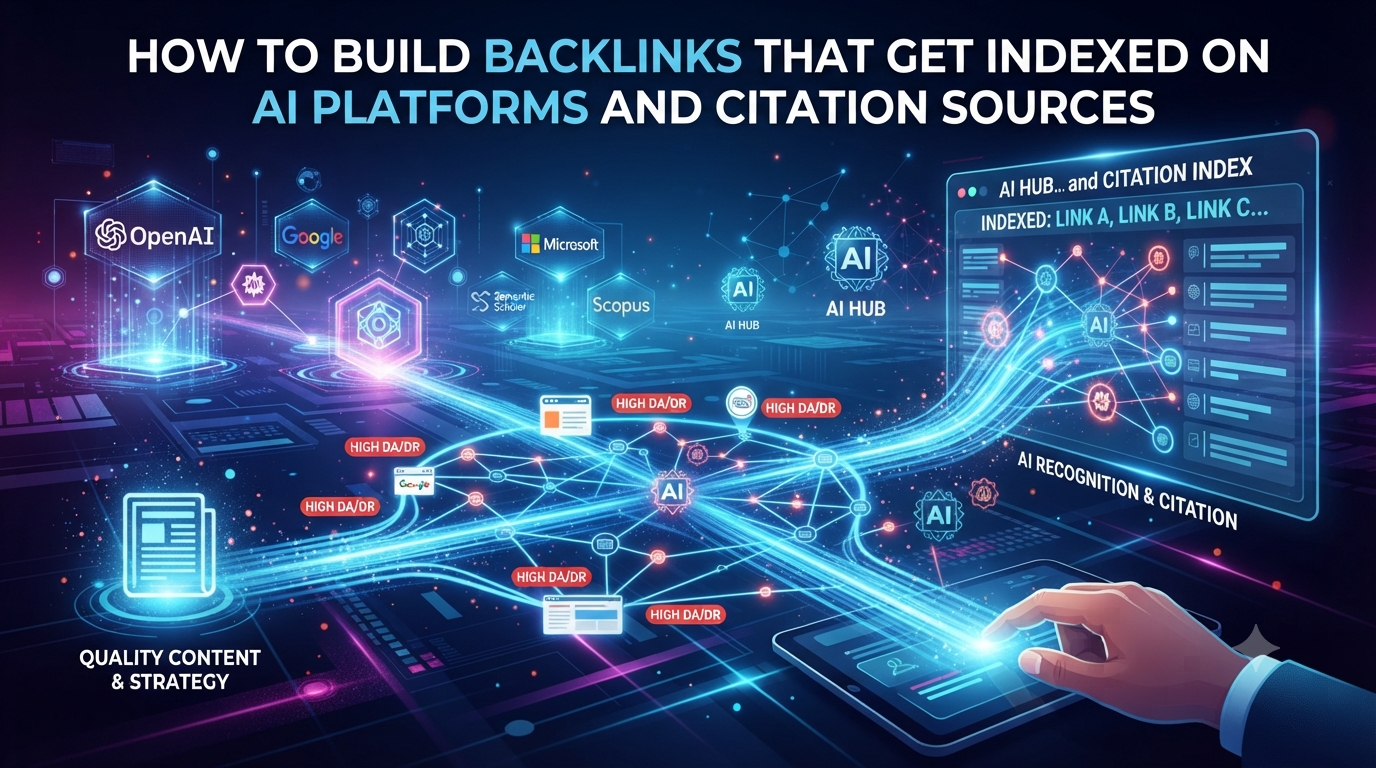
Most SEO guides tell you to build backlinks. Very few tell you how to build backlinks that actually get indexed—by both search engines and the AI platforms that are rapidly changing how people find information online.
This guide covers both. You’ll learn what makes a backlink worth building, how to create high-authority links using a real step-by-step workflow, and how to structure your content so AI platforms like ChatGPT, Perplexity, and Google AI Overviews are more likely to cite it as a trusted source.
What Are Backlinks and Why Do They Still Matter?
A backlink is simply a link from one website to yours. When a credible website links to your page, search engines treat it as a vote of trust. The more quality votes you have, the more authoritative your site appears—and the higher it ranks.
But in 2026, backlinks play a dual role. They still feed Google’s traditional ranking algorithm, but they also influence whether AI search engines pick up your content. AI platforms like ChatGPT pull results from Bing, while Google AI Overviews draw on Google’s own index. If your site has a strong backlink profile, it is more likely to be crawled, indexed, and eventually cited inside an AI-generated answer.
According to recent data, AI search visits grew 42.8% year over year, rising from 15.6 billion to 27.4 billion between Q1 2025 and Q1 2026—while Google grew just 2.4% in the same period. Around 83% of searches that trigger an AI Overview end without a single click. That means being cited inside an AI answer is now more valuable than simply ranking in a list of links.
Backlinks get you into the index. How you structure your content determines whether AI platforms quote you.
Understanding Indexing and Crawling
Before you build a single backlink, it helps to understand what happens after you publish a link.
When you publish a backlink on an external site, search engine crawlers—and AI crawlers—need to find that page, read it, and decide whether to index it. If the hosting page does not get crawled, your backlink is essentially invisible.
Google, Bing, and AI platforms all use crawlers to discover new content. Google’s crawler is called Googlebot. Perplexity has its own bot that crawls only sources it considers trustworthy. ChatGPT relies on Bing’s API, so getting indexed on Bing increases your chances of being cited in ChatGPT responses. Claude uses three separate bots—ClaudeBot, Claude-User, and Claude-SearchBot—but none of them execute JavaScript, so your backlink content needs to be visible in plain HTML.
The key takeaway: a backlink only works if the page hosting it gets indexed. This is why choosing the right platforms and promoting your content after publishing is just as important as the link itself.
What to Check Before Building a Backlink
Not all backlinks are created equal. Before you invest time in any link-building activity, run through these four checks.
1. Domain Age
Older domains generally carry more authority than brand-new ones. A website that has been around for five or ten years has had time to build its reputation with search engines. When you publish a backlink on an aged domain, that authority passes to your site. You can check a domain’s age using tools like Ahrefs, Moz, or even a free WHOIS lookup.
2. Relevance of Website Traffic
A backlink from a site in your niche is worth far more than a backlink from a completely unrelated site. If you run an SEO consultancy, a link from a digital marketing publication carries genuine weight. A link from a recipe blog does not. Check the site’s topic, its audience, and whether its traffic is real and organic before you invest time publishing there.
3. Do-Follow Links With Contextual Anchor Text
There are two types of links: do-follow and no-follow. Do-follow links pass ranking authority to your site; no-follow links do not. Before publishing on any platform, confirm it allows do-follow links. Also pay attention to anchor text—the clickable words used in the link. Contextual anchor text that describes your target page (for example, “Singapore SEO expert”) signals relevance to search engines and helps AI crawlers understand what your linked page is about.
4. Confirm the Site Actually Gets Indexed
This is the step most people skip. A backlink on a page that never gets crawled provides zero value. Before publishing, search for the domain in Google using the site: operator (e.g., site:medium.com). If thousands of pages appear, the platform is well-indexed. You can also check individual pages on the site to see whether they are showing up in search results.
How to Build High-Authority Backlinks: A Step-by-Step Workflow
The most effective backlinks do not come from spammy directories or generic link swaps. They come from high-quality content published on high-authority platforms. Here is a workflow you can follow immediately.
Step 1: Write a High-Quality, List-Based Article
List articles—also called “roundup posts”—perform exceptionally well for link building because they are genuinely useful, widely shared, and easy for AI platforms to extract and cite.
A strong example is an article titled “Top 10 SEO Experts in Singapore.” This type of article targets a specific, searchable keyword, provides value to readers researching SEO help in Singapore, and gives you a natural reason to include yourself.
Your article should be at least 800–1,000 words, well-structured with clear headings, and packed with specific detail—credentials, specialties, and links for each person mentioned. Thin, generic content will not get indexed by AI platforms and will not attract organic traffic.
Step 2: Mention Yourself First and Link to Your Target Page
List yourself as the first or second entry in the article. This is not arrogant—it is strategic. Research shows that 44.2% of ChatGPT citations come from the first 30% of a page, so placing your mention near the top increases your chances of being cited by AI engines.
In your own entry, include a do-follow link pointing to the page you want to rank. In this workflow, that would be your Singapore SEO services page (e.g., seoexpertgaurav.com/singapore-seo). Use descriptive anchor text like “experienced SEO consultant in Singapore” rather than a raw URL or something vague like “click here.”
Step 3: Publish on High-Authority Platforms
Once your article is written, publish it across multiple high-authority platforms. Each published version creates an independent backlink pointing to your target page, and the more credible platforms host your content, the more visibility you gain across both traditional search and AI citation systems.
Here are three platforms that work particularly well for this strategy:
- Medium – Medium articles are crawled and indexed by Google quickly, often within 24–48 hours. The platform has strong domain authority and is regularly cited by AI tools. Publish the full article, not just a summary, and include your do-follow link early in the content.
- LinkedIn Articles – LinkedIn has enormous domain authority and a professional audience. Publishing your article here adds a backlink from a platform that both Google and AI engines trust. LinkedIn content is also indexed by Bing, which feeds directly into ChatGPT’s citation pool.
- Google Groups – Less obvious than Medium or LinkedIn, Google Groups discussions are indexed by Google and provide a clean, text-based environment that crawlers can easily read. Post your article or a meaningful summary in a relevant group and include your link naturally within the content.
There are many other high-authority platforms beyond these three—niche forums, industry publications, community sites, and content aggregators—that can generate strong, indexed backlinks for this type of workflow. Contact Gaurav at seoexpertgaurav.com for a personalized list of platforms suited to your niche and target market.
Tier 2 Backlink Strategy: Getting Your Backlinks Indexed
Publishing your article on Medium, LinkedIn, and Google Groups gives you three solid backlinks. But there is one more step that most people miss: making sure those pages themselves get indexed.
This is called a Tier 2 backlink strategy.
A Tier 2 backlink is a link that points not to your website, but to the page hosting your backlink. So instead of building links directly to seoexpertgaurav.com/singapore-seo, you build links to your Medium article, your LinkedIn article, and your Google Groups post.
When those hosting pages attract backlinks of their own, search engine crawlers visit them more frequently—which means your backlink inside those pages gets discovered and indexed faster.
Here is how to execute this:
- After publishing your “Top 10 SEO Experts in Singapore” article on Medium, LinkedIn, and Google Groups, take note of the URLs for each published version.
- Build 5–6 additional backlinks pointing to each published article. These can come from social bookmarking sites, relevant Reddit threads, Quora answers, Pinterest pins, or web 2.0 blogs like Blogger or WordPress.com.
- You can also share the published articles on your own social media profiles—Facebook, Twitter/X, Instagram—to drive initial traffic and signal activity to crawlers.
- The goal is to get the hosting pages crawled and indexed within a few days, so your original backlink becomes active and starts passing authority to your target page.
This two-tier approach is what separates a backlink strategy that stalls from one that consistently generates results. You are not just building links—you are building a system that ensures those links get found.
How AI Platforms Cite and Index Content
Building strong backlinks improves your Google rankings, and better Google rankings increase your chances of being cited by AI platforms. But there is more you can do to make your content directly citation-worthy.
AI engines like ChatGPT, Perplexity, and Google AI Overviews do not just look at links. They analyze content quality, structure, and clarity. Here is what makes content more likely to be cited:
Place your key answer at the top. As mentioned earlier, 44.2% of ChatGPT citations come from the first 30% of a page. If your article answers a question, the answer should appear within the first two or three paragraphs—not buried at the bottom after a long introduction.
Use clear headings and structured formatting. AI crawlers read raw HTML. Use proper H1, H2, and H3 tags to organize your content. Tables, bullet points, and numbered lists make it easier for AI engines to extract specific facts and quote them accurately.
Include data and statistics with sources. Research shows that adding statistics to a page increased AI visibility by 22%. When you cite data—like the backlink statistics in this article—you give AI engines a concrete, quotable fact to include in their answers.
Publish fresh content and update regularly. Around 65% of AI bot hits target content published within the past year. Outdated articles are far less likely to be cited. If you publish a “Top 10 SEO Experts in Singapore” article, update it at least once a year to keep the content fresh and crawlable.
Be present on multiple platforms. Sites present on four or more platforms are 2.8 times more likely to appear in ChatGPT responses. Publishing across Medium, LinkedIn, Google Groups, and your own blog is not just good for backlinks—it is good for AI discoverability.
Optimize for mobile and page speed. Perplexity’s bot strongly favors fast, mobile-optimized websites. If your site loads slowly or breaks on mobile, you are reducing your chances of being cited—regardless of how strong your content is.
Putting It All Together
Let’s recap the full workflow so you can act on it right away:
- Write a well-structured, high-quality list article targeting a specific keyword (e.g., “Top 10 SEO Experts in Singapore”)
- Mention yourself first, with a do-follow link pointing to your target page and descriptive anchor text
- Publish the article on Medium, LinkedIn Articles, and Google Groups—using the same do-follow link in each
- Build 5–6 Tier 2 backlinks pointing to each published article to help those pages get indexed faster
- Structure your content with clear headings, data, and direct answers near the top so AI platforms are more likely to cite it
This strategy works because it combines two things: SEO authority through high-quality backlinks, and AI visibility through well-structured, citation-ready content.
The platforms listed in this guide are a strong starting point. But the best platforms for your specific niche and market will depend on your industry, your location, and your target keywords.
Want a personalized list of high-authority platforms where your backlinks will actually get indexed? Reach out to Gaurav at seoexpertgaurav.com and get a customized recommendation based on your goals.